Playground Lab Engineering Notes: Architecture, Security, and Delivery Decisions
Published 02/22/2026 · 8 min read
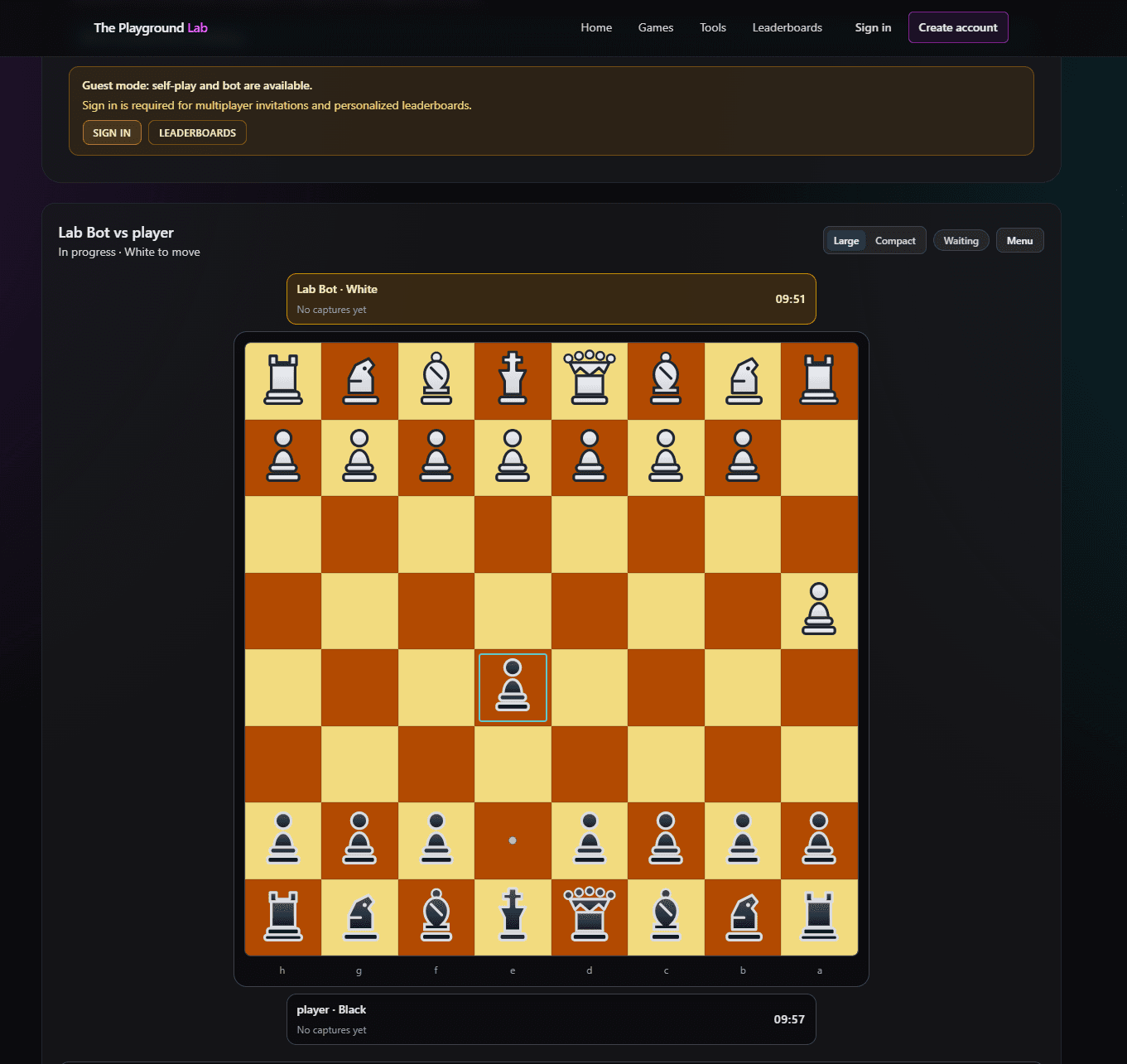
When Playground Lab started, the goal was never ‘just a game frontend and an API.’ The direction was to build a platform where new game and tool modules could grow without collapsing contracts, security boundaries, or operational clarity.
1) Why decoupled frontend and backend
- Next.js frontend and FastAPI backend run as separate services with clear ownership boundaries (UX vs domain logic).
- Deployment and runtime tuning remain independent, which keeps scaling and operational iteration cleaner.
- The trade-off is additional proxy/auth and contract discipline overhead, accepted intentionally for long-term maintainability.
2) API trust model and internal headers
Sensitive flows are not based on browser-provided identity headers. Frontend route handlers read trusted session state server-side, then inject internal headers that the backend validates before honoring internal-only behavior.
Users never see this layer directly, but it removes an entire class of identity spoofing mistakes from the public request surface.
3) Security controls beyond authentication
- Explicit CORS origin policy (no production wildcard).
- Endpoint rate limiting with transparent response headers and retry signaling.
- Admin operations guarded by both role checks and active admin-mode toggles.
- Identity normalization to reject blank or ambiguous principals before domain logic executes.
4) Mongo lifecycle and fail-fast startup
- Connect and verify DB health on boot.
- Ensure module indexes for auth/games before serving traffic.
- Seed and sync baseline catalog data where required.
- Emit startup status for operational visibility.
If core dependencies are unhealthy at startup, the service does not continue in a partially healthy state. That behavior is intentional to avoid hidden runtime failure later.
5) Contract strategy across Python and TypeScript
Pydantic schemas remain validation-authoritative on the backend, while the frontend consumes aligned typed payloads. This keeps schema drift risk low as Wordle, Chess, tools, and account flows evolve together.
python
1@lru_cache(maxsize=1)
2def _load_ranked_words() -> tuple[list[str], str, bool, str | None]:
3    try:
4        ranked = top_n_list("en", EXTENDED_POOL_SIZE * 3)
5    except Exception as error:  # noqa: BLE001
6        logger.warning("wordfreq top_n_list failed; using fallback list error=%s", error)
7        return _fallback_result(type(error).__name__)
8
9    normalized = _normalize_words(ranked)
10    if not normalized:
11        logger.warning("wordfreq produced no valid 5-letter words; using fallback list")
12        return _fallback_result("empty-wordfreq-result")
13
14    return normalized, "wordfreq", False, None
6) Deployment split and delivery posture
- Frontend on Vercel, backend on Railway, data in Atlas, edge/DNS through Cloudflare.
- Docker Compose remains the local reproducibility anchor for environment parity.
- Type safety is enforced as baseline quality posture: strict TypeScript + strict mypy mode.
7) Tricky points and practical lessons
- Keeping admin visibility aligned with real server mode state.
- Allowing guest continuity without crossing account-only boundaries.
- Designing asynchronous behavior (especially chess bot turns) without state incoherence.
- Making rate-limit behavior transparent and debuggable for client UX.
The most durable decision was treating architecture and security as product features from day one. The visible value is games and tools; the lasting value is clear trust boundaries and contracts that survive scope growth.